Showing posts with label book reviews. Show all posts

Monday, November 4, 2013

Overplaying the grace card?

I appreciate David Robertson's review of Tullian Tchividjian's new book One Way Love. Robertson gives voice to many of my own concerns about what I believe is a rising tide of antinomianism within the church, especially among the neo-Reformed.

Robertson writes:
One Way Love?  But it’s not just a problem of perception.  It’s also a problem of theology and emphasis.  I like reading the early Church Fathers, the Reformers, the Puritans and 19th Century Scottish theologians.  Maybe I am not reading them right, but I don’t see any of them writing in the general and sweeping terms that the grace-lit books do.  Maybe I need the second blessing before I get really grasp what they are saying!   But some of the statements just don’t make biblical sense to me.  For example:
“Grace is love that has nothing to do with you, the beloved.  It has everything and only to do with the lover.”  Try as I might I just don’t get that.  Of course Gods love for me has something to do with me!  Of course Gods love for me is not only to do with him.  The Son of God loved me and gave himself for me!  I know I don’t deserve it, but there is no need to mangle the English language and render it meaningless.  Whilst such sound bites might sound as though they magnify grace, I think they are superficial, trite and ultimately undermine the whole teaching about grace. 
Grace -Complaints? “Grace doesn’t make demands. It just gives.  And from our vantage point it always gives to the wrong person.”  Again this does not really make sense to me.  Is not take up your cross and follow me a demand?  Go sell all that you have and give to the poor, is that not a demand?  If you love me you will keep my commands?    And is it always the case that grace gives to the wrong person?  I honestly don’t think that God giving grace to so many of the people in St Peters is giving to the wrong person; except insofar as I am an old fashioned Scottish Calvinist who believes in total depravity and that no-one is the ‘right’ person for grace.  That’s kind of the point.  There is none righteous, no not one.  If I believe that, why would I ever look and say “Lord, you are giving grace to the wrong person”?!
I encourage you to read the entire review. There is much worth considering.

Thursday, April 26, 2012

The Constant Reader

P&R Publishing has a proven track record of publishing great books. Recently I spent time in three of their newer titles.


Giving Up Gimmicks: Reclaiming Youth Ministry An Entertainment Culture by Brian Cosby
Giving Up Gimmicks is a celebration of the ordinary yet powerful means God has given his church to win the lost and makes disciples. I wish this book had been available to me as a young youth pastor. Although Cosby's views of the sacraments are from an historic Presbyterian perspective, I would encourage every baptist youth pastor to read this book carefully.

"For more than a generation now we have sought to attract and entertain our precious youth rather than nurture them by grace. The majority have responded by turning their backs on the church. Brian Cosby has listened to their heart and is offering us the best biblical guidance we could ever hope to receive."- Michael Card, Award-winning Singer, Songwriter, and Author


7 Toxic Ideas Polluting Your Mind by Anthony Selvaggio
In this helpful book, Anthony Selvaggio examines 7 decidedly unchristian ideas that are commonly held by Christians. He takes us deeper than outward behaviors and helps us to focus on the ideas that fuel them. I think 7 Toxic Ideas is going to end up on my regular list of recommended books.

"By making good things ultimate things -- love becomes lust, rest becomes sloth, and so on -- we fall into what used to be called the seven deadly sins. We have a harder time spotting the seven modern idolatries that Anthony Selvaggio outlines for us, but the process is similar: individuality becomes individualism, equal opportunity becomes egalitarianism, and so on. Seven Toxic Ideas Polluting Your Mind helps us to spot those current tendencies and, with God’s grace, contain them."- Marvin Olasky, Editor-in-chief, WORLD


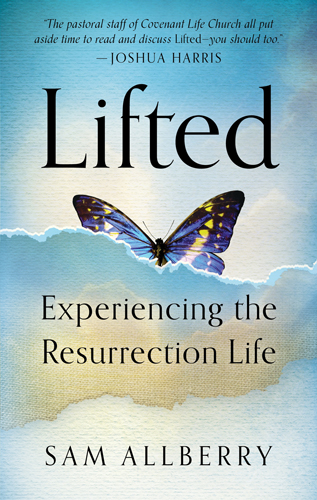
Lifted: Experiencing the Resurrection Life by Sam Allberry
It is an unfortunate reality that the resurrection of Jesus is a subject that has inexplicably been neglected compared to other important doctrines. Sam Allberry has written a book that seeks to help the reader understand the present power of Jesus' resurrection in the lives of all those who believe. Don't make your consideration of the resurrection of Jesus something that is confined to one Sunday in the Spring. Allberry helps us to understand how our joy, hope, assurance of salvation, and transformation are all tethered to Jesus' resurrection.

"Sam Allberry has written a wonderful book on the significance of the resurrection. Full of great images, clearly organized, encouraging, humorous, biblical, insightful – I could go on. Reading this little volume on a central but neglected topic will benefit your life. If you would like more assurance, transformation, hope and purpose, this book shows you how we get all that from the resurrection of Christ."
- Mark Dever, Pastor of Capitol Hill Baptist Church, Washington DC

Tuesday, March 13, 2012

The Constant Reader

I am launching a new feature at 1517 called "The Constant Reader." The goal will be to offer book reviews, recommendations, as well as words of caution concerning problematic books. One of God's good gifts to me as a pastor is the responsibility to study and read. It is a discipline I love and take seriously. I also know that the average non-pastor does not have the time or energy to be fully aware of the best and worst books out there (and there are plenty in both categories). My hope is to to give regular help to anyone interested in better navigating the waters, so to speak.

Here are a few titles that I will soon be weighing in on:

Understanding Scripture, Grudem, Collins, and Schreiner editors


The Renewed Pastor, Melvin Tinker editor


In the meantime, you can check out a review I wrote for Thomas Schreiner's outstanding Magnifying God in Christ - HERE.

Thursday, March 8, 2012

From Revival to Revivalism

Iaian Murray's excellent book Revival and Revivalism traces the history of American evangelicalism from 1750-1858 with special emphasis on the birth of revivalism and the troubling practices that ensued. This history matters because it truly helps to explain how specific doctrines and practices deviated (and continue to deviate) so drastically from what is prescribed in Scripture.


The latest edition of the 9Marks Journal includes a review of Revival and Revivalism by Bobby Jamieson. He writes:

By the 1820s and 1830s, two major shifts had occurred throughout American evangelicalism.

The first is a doctrinal shift regarding conversion. Up to 1800, evangelicals almost universally believed and preached that God must sovereignly give someone a new nature to enable him or her to repent and believe. By the 1830s, this was widely replaced by an understanding of conversion in which the decision to repent and believe lay entirely within an individual’s own power.

This led to (or, in some cases, followed) a shift in evangelistic practice. Many evangelicals adopted practices that sought to bring about an immediate decision. The “anxious bench,” the altar call, singling people out personally in public prayer, warning hearers to respond immediately or else lose their chance to repent—all these practices and more grew out of the new belief that conversion is something within a person’s power to achieve, or even to effect in others.

The Result: Revivalism

The result of these two shifts is that church leaders began to regard revival as something that could be infallibly secured through the use of proper means—“proper” being whatever would induce an immediate decision or external token of decision. This understanding was most vigorously promoted by Charles Finney, but by the end of the Second Great Awakening it had become a given among a strong majority of American evangelicals. Historian William McLoughlin even went so far as to say that by the mid-nineteenth century, this new system was the national religion of the United States (277).

Thus, revivalism was born. To be sure, revivalism grew up in the soil of genuine revival. But this new practice of revivalism radically differed from the previous understanding of revival it so quickly supplanted. A “revival” became synonymous with a meeting designed to promote revival. Unlike previous generations, evangelicals after 1830 gained the ability, so to speak, to put a revival on the calendar months in advance.

The goal of such revivals was to secure as many immediate decisions for Christ as possible. As such, awareness of the possibility of false conversion seemed to simply vanish from the evangelical consciousness. Few asked whether their new measures just might create as many false converts as true disciples.

Read the entire review HERE.

Wednesday, March 7, 2012

Why You Should Read Carl Trueman...

On losing the sense of God's holiness in the church:

When prayers become the equivalent of "Yo, how you doin'?!" then something has gone awry. Public prayers should lead people into the presence of God, and that should be a humbling, if not crushing experience. When was the last time a pulpit prayer left you in awe of the God who humbles himself so that you might worship him? What about sermons? How many of us sit in judgment on the sermon, grading it for quality, length, clarity, interest, as the minister brings to us the Word of God? If we have any grasp of God's holiness, and any inkling of the importance of the prophetic task of preaching, we won't be giving the minister a grade; rather, we will be sitting and listening to what he has to say, acutely conscious of our own unworthiness to hear God as he speaks to us. Then, when the songs we sing can be summarized by the phrase, "Jesus is my best boyfriend," we can be sure that something is seriously out of joint. The words we sing to God should reflect the gravity of the words of God first speaks to us. Then, when the church itself becomes a take-it-or-leave-it venture that we can turn up for a time that suits us, perhaps even sipping lattes from Starbucks as we take our seats, something is seriously missing. What is it? Well, the answer isn't rocket science: a sense of the deep holiness of God. The casual nature of the postmodern world, where all hierarchies are oppressive and the consumer is king, cannot even begin to understand the void that lies at the heart of such slapdash Christianity. Your doctrine can be as correct and confessional as possible; but if it is all just so much of a game, then it is no theology at all.

That passage is from Dr. Trueman's newest collection of essays entitled Fools Rush In Where Monkeys Fear To Tread (pp. 65-66). If you are familiar with Trueman's writing then the subtitle will make perfect sense: "Taking Aim At Everyone." One of the reasons I like reading Carl's essays is because he refuses to bow to the ever-changing standards of sentimental niceness. If you wear your feelings on your fingertips tread cautiously. But read none-the-less.


Trueman is a professor of church history and historical theology. But he is also a keen observer of the culture. So whether he is recalling a chance meeting with Joe Frazier, extolling the virtues of Mott The Hoople (don't ask), or skewering the latest banalities of contemporary evangelicalism you can count on plenty of theological reflection. He makes it look easy, but it ain't. So don't try this at home kids. Just pick up Fools Rush In Where Monkeys Fear To Tread and enjoy.

Incidentally, I rather like the cover illustration on this new book. But, and I will take this up with Carl personally, the illustrator gave him entirely too much hair.


You can check out some of Dr. Trueman's other titles HERE.

Dr. Trueman blogs regularly at Ref21.

Tuesday, February 21, 2012

Lloyd-Jones on "Spiritual Depression"

Martyn Lloyd-Jones' classic Spiritual Depression: Its Causes and Cure has been published in a new edition which includes a CD of the Dr's sermons on the topic. If you have never read this excellent work it would be worth your time.


Check out Dan Phillips' review HERE.


Thursday, January 5, 2012

Be Discerning!

I recently posted some comments and a review of the Christian bestseller Jesus Calling. It is a book that has enjoyed a wide readership. The fans of Jesus Calling are deeply enthusiastic. It is, however, a troubling book in that the author Sarah Young claims that the words of the book were given to her directly from Jesus (or, "The Presence"). Interestingly, Young claims that only the Bible is inerrant and that the words that Jesus gave her are not as authoritative as those found in Scripture. But this begs the question: Why are the words Jesus gave directly to Sarah Young less authoritative, binding, or inerrant than those words given directly to Moses, the prophets, or the apostles?

Have evangelicals lost their discernment? Have they lost the stomach to ask critical questions? Are they able to ask, "Is this biblical?" and back it up with adequate knowledge from the Scriptures?

Last week while I was minding my own business in Barnes and Noble I was visually assaulted by the latest edition of Heaven Is For Real. This one was extra big and entitled Heaven Is For Real For Kids! What's amazing is that the first edition does not qualify as being "for kids." But I digress. Anyway, as I maneuvered around the case of books I noticed yet another "I went to Heaven but God sent me back because I'm too important for his purposes" book.

As I have pointed out before (here and here) one of the reasons I am so troubled by these books, and others like them, is that they undermine confidence in the sufficiency of Scripture. Why do we need Sarah Young's less inspired and potentially errant words directly from Jesus when the Bible gives us the fully inspired and inerrant Word of God? Why do we need Todd Burpo to assure us that Heaven is for real when the Bible already does?

Someone with whom I am close recently had a conversation with a precious saint. This wonderful person has been a Christian for many years. And yet, having been so captivated by Heaven Is Real she assured my friend that we will have wings in Heaven because the Burpo kid says so.

Brothers and sisters, we can do better than this. We must do better than this. It does not honor God, who gave us His Word and two thousand years of faithful witnesses, when we gather to ourselves tellers of tall tales and mystic guides. For God's sake and our own good let us do better.

Thursday, December 22, 2011

"Jesus Calling" A Review

Tim Challies reviews Sarah Young's enormously popular book Jesus Calling. In it, Young claims direct revelation from Jesus Christ. Oddly, while Young claims the entries in her book are the words of Jesus delivered to her, she cautions the reader to not regard them as authoritative as Scripture. But how can this be? If her book is Jesus speaking (which she explicitly claims) then how can those words be less authoritative or binding as the Scriptures? Indeed, if Mrs. Young has written down the words of Jesus that He spoke directly to her, then how can they not be Scripture? Unfortunately, her many admirers seem not to mind her troubling claim or incoherent contradiction.

Challies writes:


James Montgomery Boice once said that the real battle in our times would not be the inerrancy or infallibility of Scripture, but its sufficiency—are we going to rely on the Bible or will we continually long for other revelation? In Jesus Calling we see this so clearly. Young teaches that though the Bible is inerrant and infallible, it is insufficient. It was not enough for her and, implicitly, she teaches that it cannot be enough for us. After all, it was not reading Scripture that proved her most important spiritual discipline, but this listening, this receiving of messages from the Lord. It is not Scripture she brings to us, not primarily anyway, but these messages from Jesus.

On this basis alone this book is very suspect and needs to be treated with the utmost care. Young offers us words that she insists come straight from the Lord. But she gives no proof that we should expect the Lord to speak to us this way; all she offers is her own experience of it. At this point we are left with a few options. We can stop reading altogether, we can continue to read while rejecting her claims that these are words from the Lord, or we can read and take her at her word. Personally, unless reviewing the book, I would abandon it immediately. If she claims to be speaking Jesus’ words, I am no longer interested. However, for the sake of reviewing it, I continued to read.
Dr. Boice was right. Clearly, the battle over inerrancy continues. But more often it is the sufficiency of Scripture that is under constant attack in evangelical circles. "God told me," "God spoke this word in my heart," etc are frequent appeals to extra-biblical revelation. And yet such claims are ubiquitous among evangelicals. We make bestsellers out of fanciful tales of people's trips to heaven. How gullible have we become? We must ask, "When did God's Word become insufficient?" When did the Bible need the help of mystical experiences? extra words from God? or a little boy's trip to heaven and back?

Challies continues:


It is interesting that the majority of the devotionals are affirmations rather than commandments which means that the book tends to be more descriptive than prescriptive. It is less about Jesus telling how we are to live, but more about who he is, who we are, and how to enjoy his Presence. It is notable that these affirmations span only a very narrow range of the Christian experience. It is equally notable that many of Jesus’ words sound very little like what he says in the Bible. For example, “Let the Light of My Presence soak into you, as you focus your thoughts on Me.” And shortly after, “Learn to hide in the secret of My Presence, even as you carry out your duties in the world.” I do not even know what that means or how it might be applied. There is no clear command there for me to obey and no clear word about who Jesus is.


Conclusion
Jesus Calling is, in its own way, a very dangerous book. Though the theology is largely sound enough, my great concern is that it teaches that hearing words directly from Jesus and then sharing these words with others is the normal Christian experience. In fact, it elevates this experience over all others. And this is a dangerous precedent to set. I see no reason that I would ever recommend this book.

Read the entire review HERE

Wednesday, August 3, 2011

DeYoung Reviews Smith

Keving DeYoung has posted a helpful review of Christian Smith's new book The Bible Made Impossible. Smith, a professor from Notre Dame has previously written the thought provoking volumes Soul Searching and Souls in Transition. They are studies of the religious beliefs and practices of younger Americans. I recommend both titles. However, in his latest book Smith offers a heavy handed critique of evangelicals who hold to the inerrancy and clarity of Scripture. In his review, DeYoung offers a compelling reply.

Monday, April 4, 2011

Something old but nothing at all new...

The Daily Caller is running David Lee's review of Love Wins. Lee concludes that Rob Bell is not really saying anything new. He is simply repeating the same sort of theological liberalism of the 19th and early 20th centuries that robed the cross of its power and turned Christianity into a collection of timeless universal principles.
Bell’s book is causing such a stir because it strikes at a fundamental debate: Is Christianity a revealed religion, one that rises or falls on its objective truth? Or is it merely an expression of timeless spiritual truths, perhaps one among many religions that capture the inner longing of mankind?

Bell’s side in this debate is illustrated by a curious omission. In a book about the love of God, Bell fails to mention one of the most profound and mysterious claims the Bible makes about the subject:

“By this we know love, that He laid down His life for us.” (1 John 3.7)

This verse at once offends and amazes. It offends, because as revealed religion it claims that we don’t even know what love is, apart from God revealing it to us. It amazes by suggesting that this revelation of God’s love took place on a cross, an international symbol of suffering, criminality, and folly. Weird, strange stuff. Exactly what you get in revealed religion.

And it’s not a throw-away line. “God is love,” the Apostle John tells us a few lines later, in one of the most famous, most quoted lines about God’s love. But he continues: “And in this is love, not that we have loved God but that he loved us and sent his son to be a sacrifice for our sins.” “God is love” only makes sense in the light of the cross.

Explain how the death of a Jewish man on a cross illustrated God’s love, and you explain Christianity. Bell’s book not only fails to do so, it barely makes an attempt.


Read the entire article
HERE.

Thursday, March 24, 2011

Horton on "Love Wins" cont...


Michael Horton continues his thorough review of Love Wins HERE and HERE.


You can read parts one and two HERE.

Monday, March 14, 2011

Reviews of "Love Wins"


Kevin DeYoung and Denny Burk have posted their reviews of Rob Bell's Love Wins. I strongly encourage you to read both reviews. They are models of thoughtful engagement and sound theology.

Kevin's Review
HERE.

Denny's Review
HERE.

Denny Burk also references Richard Mouw's review of Love Wins. Dr. Mouw is the president of Fuller Theological Seminary in Pasadena, California. Bell is a graduate of Fuller and friend of Mouw.

USA Today reports on Mouw's favorable review:

Richard Mouw, president of the world’s largest Protestant seminary, Fuller Theological Seminary based in Pasadena, Calif., calls Love Wins “a great book, well within the bounds of orthodox Christianity and passionate about Jesus.

The real hellacious fight, says Mouw, a friend of Bell, a Fuller graduate, is between “generous orthodoxy and stingy orthodoxy. There are stingy people who just want to consign many others to hell and only a few to heaven and take delight in the idea. But Rob Bell allows for a lot of mystery in how Jesus reaches people.”

Dr. Mouw repeats a tired and irresponsible accusation against those who uphold the biblical teachings on hell and the judgment of God: that they "take delight in the idea" of hell. Richard Mouw and Fuller Seminary are coming to represent what "big tent evangelicalism" has become. Surely Dr. Mouw would not make this accusation against Jesus who himself said that the way to life is narrow and few find it while the way to destruction is wide and many find it. Does this make Jesus "stingy"? Does this means Jesus "takes delight in" hell? As far the Rob Bell allowing "for a lot of mystery," of that there is little doubt. They only thing Rob Bell seems to make clear is that Jesus cannot possibly mean what he said.

Friday, December 17, 2010

Book Review


My Review of Carl Trueman's Histories and Fallacies has now been posted at TGC Reviews.

Histories and Fallacies is a different kind of book for Carl Trueman. He is accustomed to writing history, not about how history ought to be written. In a rather candid moment Trueman admits that his view of the historical task formerly mirrored Shaw’s attitude toward teachers: “those who can write history, do write history; those who cannot, write books telling others how to do it” (p. 13). Thankfully, however, Trueman has come to believe that there is indeed a place for the historian to weigh in on those questions that underlie the task of writing history.

Not only is Histories and Fallacies a different kind of book for Trueman, it is a different kind of book for Crossway. That is, it is not an explicitly “Christian” book as we tend to measure such things in our present moment. I commend Crossway for publishing such a work. For while this present volume does not deal with explicitly Christian themes in the sense that a book on the doctrine of Christ does, Histories and Fallacies is nevertheless an important book for Christians whose hope is wrapped up in thousands of years of history. After all, we say that our salvation depends upon a series of objective events in the past. Christians, therefore, ought to be competent historians.

Trueman readily admits that there are unavoidably subjective realities in the interpreting and writing of history. “History,” he writes, “is not simply a collation of facts which can only be related together in one valid narrative” (p. 17). However, as we consider the past we must “rule out of bounds the possibility that there are a potentially infinite number of sometimes contradictory yet equally valid ways of talking about the past” (p. 17). Using the rather amusing example of theories suggesting that Elvis is “still alive and well and working as a shelf-stacker in a supermarket,” Trueman warns against “a kind of epistemological nihilism that has so relativized everything that access to the past in any meaningful way is virtually denied” (p. 18). This, I suggest is the heart of Histories and Fallacies. It is also the reason why this volume is important. Many of us who labor as pastors are often confronted with the fruit of historical deconstructionism and “epistemological nihilism,” which has become rather chic in certain evangelical circles.
Read the entire review HERE.

Friday, October 15, 2010

My review of a "A Place for Weakness"


TGC Reviews has just posted my review of Michael Horton's A Place for Weakness.

One of the things I appreciate about Michael Horton is that he writes both for the academy and also the congregation. It’s a mark of a good theologian to do both well. Horton is a professor of apologetics and theology at Westminster Seminary California. Some of his outstanding titles include Putting Amazing Back Into Grace, People and Place, We Believe, and A Better Way. He is also the publisher of the indispensible monthly journal Modern Reformation and host of the White Horse Inn radio program.

This relatively slim volume was originally published with the title Too Good to Be True: Finding Hope in a World of Hype, which I rather liked. Zondervan has released it with a new title and a new cover, and I am glad that new attention is being given to this outstanding book.

A Place for Weakness is driven along by an unrelenting but refreshing realism. There are no false promises here. There are no clichés or newly discovered secrets for “living in victory.” Horton helps us understand suffering as unromantic but deeply purposeful. In other words, we do not have to pretend that suffering does not hurt and cause dismay. At the same time, we are confidently pointed to the mysterious comfort that everything that comes our way passes through the hands of our good and sovereign God. “The unity of God’s sovereignty and goodness that will be finally disclosed on the last day has already dawned decisively in the work of Christ” (45).

Read the entire review HERE.

Wednesday, September 1, 2010

"Why Johnny Can't Sing Hymns"


My review of T. David Gordon's Why Johnny Can't Sing Hymns has now been posted TGC Reviews.

Gordon makes a compelling series of arguments against the use of pop music in corporate worship. His arguments focus primarily on the three dimensions mentioned above: the literary, theological, and musical merit (or lack thereof) of pop music. Two of the problems, perhaps the most significant problems with pop music according to Gordon are its 1) profanity, that is, it is common; and its 2) ubiquity, that is, it is everywhere. It operates like a kind of white noise in our culture.

Certainly many will challenge Gordon’s assessment of the relative importance of the music itself compared to the lyrical content of the songs. But part and parcel of the book’s thesis is that form is far from neutral. Indeed, it is foolish to try to separate form from content. As Gordon asserts, “We make tools and tools make us” (p. 10).

Gordon places “paedocentrism” near the center of the present soiling of corporate worship. “Reaching the young” has become for the church what “doing it for the children” is for politicians. After all, who opposes reaching young people? But Gordon challenges this paedocentrism. “Biblically, the goal of youth is to leave it as rapidly as possible. The goal of the young, biblically, is to be mature. . . . We equate youth with youth culture, and erroneously believe that we cannot minister to the one without embracing, condoning, or promoting the other” (p. 161).

What is more, Gordon challenges the assumption of many baby boomers that pop music forms in worship is an effective way to reach young people. One of the “money quotes” from the book is, “Young people who attend a church and see a group of fifty-year-olds playing their guitars in front of the church in order to ‘reach the young’ will perhaps politely appreciate the gesture, but they frankly regard the music as being fairly lame” (p. 159).
Read the entire review HERE.

Tuesday, July 6, 2010

Great new book on evangelism...


My latest book review (Marks of the Messenger) is up at TGC Reviews.


Let me begin with some self-disclosure. I don’t like books on evangelism. I find most of them to be profoundly unhelpful. Some of them are simply bad books. Some are little more than a series of anecdotes strung together. Worse, some of them, while heavy on methodology, (astonishingly!) get the Gospel wrong. Still others heap an enormous amount of guilt upon the unsuspecting reader.

There are some notable exceptions of course. The outstanding Evangelism and the Sovereignty of God by J.I. Packer opened my eyes to the relationship between the providence of God and the witness of his people. Bruce Metzger’s Tell the Truth drove a stake through the heart of my previously man-centered notions of evangelism. Both of these books ought to be on every Christian’s shelf.

I am pleased to say that there is another volume to add to that short list. Marks of the Messenger by J. Mack Stiles just may become my new “go-to” book for evangelism. It may be that this book is helpful precisely because its author has for years integrated his profession with a strong sense of responsibility to advance the Gospel. Currently, Stiles lives in the United Arab Emirates where he serves as CEO of Gulf Digital Solutions and is general secretary for the Fellowship of Christian UAE students (FOCUS).

The goal of Marks of the Messenger is to make the reader a better evangelist. I suppose that is the target toward which all books on evangelism aim. But through biblical fidelity and shear simplicity I think Stiles’ book may actually accomplish this for many. Nowhere does one get the idea that Stiles is some sort of superhuman witnessing machine. This is helpful for those of us who are quite sure we do not possess a “gift” for evangelism but nevertheless desire to be better witnesses.
Read the entire review HERE.

Tuesday, June 15, 2010

"The Hole In Our Gospel" - A Review


Kevin DeYoung has written a thoughtful and helpful review of Rich Stearns book The Whole in Our Gospel.

DeYoung voices the very concerns I have about the book. First of all it should be said that Stearns is absolutely right in calling us to care for the poor. No follower of Jesus can ignore the plight of those who are suffering. However, it does matter how we understand and then respond to the challenge of poverty and suffering. Our own experience has taught us that many good intentions have suffered from the law of unintended consequences. That is, many efforts to help the poor have unintentionally ended up causing great harm. So it is very important that we exercise great care in the manner in which we offer help. It is also vitally important that we not distort or misappropriate essential doctrines in the course of calling Christians to action. The title of Stearns' book is quite ambitious. He is suggesting that we have missed something essential about the Gospel. So it is necessary that his handling of the Gospel, no small matter to the apostle Paul, be scrutinized.

While appreciating Stearns' motives and worthy call, DeYoung challenges both the economic assumptions in "The Whole in Our Gospel" and, more importantly, the doctrinal formulations.

The Hole in Our Gospel marginalizes what is central to the gospel. To be fair, Stearns acknowledges that reconciliation between God and man through the atoning work of Christ is part of the gospel (15). But the whole gospel, says Stearns over and over, is God’s vision for a new way of living (276). The “essence” of the good news is that God’s kingdom is going to begin on earth through the changed lives of His followers. But Stearns doesn’t make clear how one enters this kingdom, or that the in-breaking of the kingdom is bad news for those who oppose God and do not trust in Jesus Christ. No doubt, Stearns would agree with the apostle Paul that the gospel is the good news that Christ died for our sins in accordance with the Scriptures, that He was buried, and that He was raised from the dead and appeared to many witnesses (1 Cor. 15:3-8). But what Paul labels “as of first importance,” I hear Stearns demeaning as a diminished gospel (279).

It seems that for Stearns the gospel is primarily something we do. The gospel is not an announcement of what God has done for us in history. The gospel is a “social revolution” (20). At one point, after quoting 2 Corinthians 5:20 that we are “Christ’s ambassadors as though God were making his appeal through us,” Stearns says, “God chose us to be His representatives. He called us to go out, to proclaim the ‘good news’—to be the ‘good news’—and to change the world” (3). This is certainly a curious gloss on what it means for God to make His appeal through us.

Frankly, for all its laudable exhortations, I find Stearns’s gospel exhausting and even triumphalistic and paternalistic at times. I can’t count all the times in the book we are told to change the world, start a social revolution, or usher in the kingdom of God. If only we gave more or had the will, we could eradicate hunger and win the war on poverty. For the first time in history we have the know-how and access to solve these problems, we are told. Now we just have to make it happen. The church around the world is waiting us for us to act. Without our efforts and resources directed toward the developing world, their lot in life will never improve. According to Stearns, “This is not to be a far-off and distant kingdom to be experienced only in the afterlife. Christ’s vision was of a redeemed world order populated by redeemed people—now…It’s up to us. We are to be the change” (243–44, emphasis in original). Does God’s reign and rule really depend on us?

I think I know where Stearns is coming from. He wants our faith to work. He wants Christians to care about the world and not just about their “fire insurance.” I get that. I applaud that. He should be more careful in talking about the gospel, however, lest it become a generic message about how God is going to make the world a better place. “Preach the gospel always; when necessary use words” (23) is not a helpful saying. Besides the fact that there’s no record that St. Francis ever said this and every indication that he didn’t live this way, the pithy saying represents a confusion of categories. We must use words if we are to preach the gospel, because the gospel is a message we must proclaim. If we never live like Christians, we are not Christians. But to tell people that they must repent and believe in Jesus for the remission of sins, to tell them that God sent His Son in love to bear His just wrath, to tell them that they must receive the kingdom in faith like little children, is not a
gospel with a hole in it. It is precisely the center, and Stearns’s call to action would have been more compelling if it more clearly radiated from there.

This crystalizes well my own reservations about The Hole in Our Gospel. It matters that we get the Gospel right. Indeed, Paul called the Gospel (the message of Christ's death for sinners and glorious resurrection) the "matter of first importance" (1 Cor 15). Stearns makes the same mistakes of the social gospel movement in the early 20th century. It is a confusion between what the Gospel is and what the Gospel produces. It is a confusion of the root and the fruit. The Gospel is the announcement of what God has done through Jesus Christ. The Gospel is not our obedience. Herman Bavinck wrote, "The Gospel is sheer good tidings, not demand but promise, not duty but gift."

When we confuse the Gospel (what God has done in Christ) with the implications of the Gospel (our grateful, obedient response) then we distort, even destroy the Gospel. We turn grace into law. We turn gift into duty. We turn ourselves into moralists. It matters.

Read DeYoung's entire review HERE.

I would recommend the outstanding When Helping Hurts: How to Alleviate Poverty without Hurting the Poor and Yourself.

"Becoming more and more aware of the poverty in the world, the North American church is responding and ministering to the poor in unprecedented numbers. But this is easier said than done, as poverty is a complex problem. Good intentions are not enough, for faulty assumptions can result in strategies that do considerable harm. If churches truly want to help, this book is a must-read. It presents a biblically based framework for understanding poverty and its alleviation. The principles and strategies will help the church build an effective ministry for a hurting world, both at home and abroad."
- Dr. Paul Kooistra, Executive Director of Mission to the World

  "Globalization, immigration, and suburbanization are bringing new opportunities to minister to the poor to the front doorsteps of many North American churches. We must not repeat the mistakes of the past by running away from those whom Jesus loves so deeply. Rather, we must learn how to walk with our new neighbors in highly transformative relationships. There is no simple route to success, but this book provides a marvelous compass to guide our steps. I highly recommend it to any church that wants to be "the body" to the world outside its doors."
- Jim Bland, Executive Director, Mission to North America

Friday, June 11, 2010

Iain Campbell reviews "Doctrine"


Iain Campbell has written a glowing review of Doctrine by Mark Driscoll and Gary Breshears. Not surprisingly, Campbell quibbles with a few issues (there is no such thing as a perfect book). He is cautious about Driscoll and Breshear's views of God speaking in our day as well as what they call "unlimited limited atonement" which can be a bit confusing. However, Campbell calls Doctrine "the sort of book I want to write some day." I'd call that an endorsement.

Read the review HERE.

Some other doctrinal primers that I highly recommend are:

A Faith to Live By by Donald MacLeod
Know the Truth by Bruce Milne
Concise Theology by J.I. Packer

Wednesday, June 9, 2010

Don't divorce Christianity from the Body of Christ


Trevin Wax has posted a very helpful review of the late Michael Spencer's recently released "Mere Churchianity." While Trevin finds some very helpful moments in the book he takes issue with what seems to be the recurring problem: "pitting a Jesus-shaped spirituality against a church-shaped spirituality."

Spencer not only does not blame Christians for abandoning the church, he seems to encourage it. On page 57 he writes, "For many of you, leaving the church may have been the most spiritually healthy thing you ever did." Spencer also seems to have had a deficient view of the very nature of the church. On page 6 he refers to the church disparagingly as a "religious institution." On the one hand, I suppose you could call the church a religious institution. But the Scriptures call the church the Body and Bride of Christ.

What is more Spencer states that, "Life as a Jesus-follower grows out of Jesus and the gospel, not out of the church." I challenge anyone to find anywhere in the Bible where being one of God's people under the Old or New Covenants is divorced from being a member of His covenant people. The fact is, the New Testament teaches that Jesus-followers are indeed made by the church. Disciples are made and grown in the church.


Does the church always do this well? Of course not. Is the church always loving and affirming? No. But the reason for this is not because the church is an idea whose time has come. The church is often a mess because Christians are often a mess.

Trevin writes:

Michael rightly teaches that the gospel is for people who recognize they are messed up, rebellious, sinful, broken and dysfunctional. Christianity is for the losers, for the people who recognize their need for salvation outside of themselves. So far so good.

But let’s engage in a bit of logic. If churches are organized groups of these messed up, broken, dysfunctional people, why in the world would we expect the church to always live up to some unattainably high ideal? I’m not saying we shouldn’t shoot high. I’m not saying we should be satisfied with Christless churches. But surely Michael should give groups of broken people (churches) the same patience he gives individual broken people.

So in the end, I want to say, “Michael, you’re right about individual Christians. We’re broken, wounded, sinful and selfish. So why can’t you see that churches are going to be that way too? Please don’t encourage broken people to leave churches that are broken! Just as we need Jesus in us as individuals to slowly remake us into his image, we need Jesus-filled people in churches if there is any hope for the church to reflect the glory of Christ to the world.”

If Christ remains committed to us – as broken and messed up as we are – why would we not remain committed to his followers? Why would we bolt out the door when our church experience becomes a hassle? What looks more like Jesus – to hit the road? Or to stay with a congregation through thick and thin, through good and bad?

Michael thinks the church’s problems are an obstacle to Jesus-shaped spirituality. I think the opposite: commitment to bear with the church’s problems is the method by which we become more Jesus-shaped.

Read the entire review HERE.

Tuesday, June 1, 2010

Become a Better Bible Interpreter


I have just begun reading 40 Questions About Interpreting the Bible by Robert Plummer and it is outstanding.

Here is what Justin Taylor has to say about it:

Robert Plummer’s new book, 40 Questions About Interpreting the Bible (Kregel, 2010), is simply excellent.

For most books on biblical interpretation, I’d want to qualify the recommendation by specifying the target audience. (For example, seminarians should probably buy Grant Osborne’s The Hermeneutical Spiral but it’s probably not a good text for most Sunday School classes. On the other hand, Nigel Beyon and Andrew Sach’s new Dig Deeper: Tools for Understanding God’s Word is very helpful for a lay level but wouldn’t be used as a seminary course textbook. (For more on this one, see this interview by Josh Harris.)

But Dr. Plummer—who teaches at Southern Seminary—has managed to produce something pretty unique here. I’d recommend it for virtually all Christians: laypeople, parents, pastors, and professors. If I were teaching a Sunday School, college, or even seminary class, I’d make this required reading (though obviously the higher the level of class the more supplemental reading would be required).

I can see a lot of folks using this as a one-stop introductory resource on questions of text, canon, translation, inerrancy, Christ-centered interpretation, application, genre, etc. Pastors in particular: this is a very good resource for producing concise, excellent answers for most of the questions people ask about matters of the Bible.

The section on “Issues in Recent Discussion” also concisely and helpfully covers issues like speech-act theory, “theological interpretation of Scripture,” and other issues.

Quite simply, this is the best introductory book on biblical interpretation I’ve yet seen. I highly recommend it.